


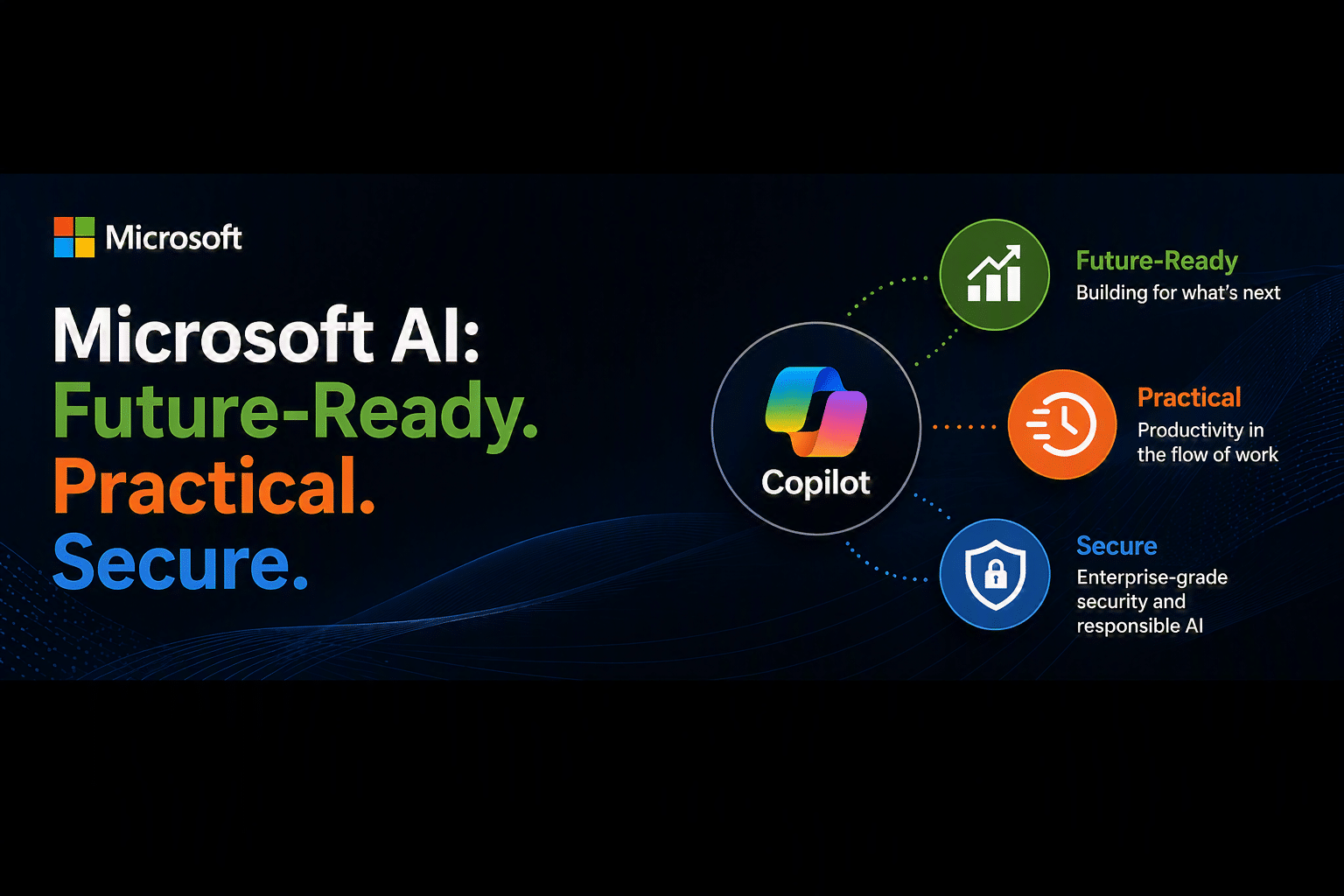
Microsoft’s approach to AI—through platforms like Microsoft 365 Copilot, Azure AI, and its broader ecosystem—stands out because it doesn’t focus on hype. It focuses on structured, business-ready adoption grounded in productivity, governance, and long-term scalability.
Future Readiness: Building AI into the Core of Business Operations
Microsoft’s AI strategy is centred on preparing organisations for continuous change, not just immediate gains.
Rather than treating AI as a bolt-on tool, Microsoft embeds AI across its platform—from productivity applications to cloud infrastructure. This ensures businesses are not just adopting AI for today’s tasks, but building a foundation for future innovation.
- AI is integrated directly into everyday tools like Outlook, Teams, Excel, and Word
- Azure provides scalable infrastructure to support growing AI workloads
- AI models and agents can evolve as business needs change
- Organisations can move from simple automation to more advanced, agent-driven workflows
This approach removes the need for businesses to constantly re-platform or invest in disconnected solutions. Instead, they build on a single, evolving ecosystem that supports long-term digital transformation.
For SMEs in particular, this is critical. AI is not a one-time project—it is an ongoing capability that will shape how businesses operate, compete, and grow.
Convenience: Turning AI into Real Productivity Gains
The real value of AI is not in complex models—it is in everyday impact.
Microsoft’s Copilot approach focuses on embedding AI directly into the flow of work, making it accessible to all employees without requiring technical expertise.
From a practical perspective, this means:
- Emails, documents, and meetings can be summarised automatically
- Reports and data analysis can be generated in seconds
- Routine administrative tasks can be automated
- Data from multiple systems can be brought together into a single view
SME Example: AI in a Distribution Business
Take a mid-sized distribution company managing deliveries, suppliers, and customer orders.
Each morning, the operations manager typically faces:
- Dozens of emails from suppliers and customers
- Multiple Excel reports tracking deliveries and stock
- Ongoing delays that require quick decisions
With Microsoft 365 Copilot in place, the workflow changes significantly.
- Copilot summarises overnight emails and highlights urgent issues
- AI in Excel identifies delivery delays and suggests improved routes
- Reports are automatically updated with real-time data
- Key operational insights are pulled into a single dashboard
As demonstrated in your Unitec event materials, this type of setup can save 2–3 hours per day on administration and reporting, while improving decision-making speed and operational visibility.
The result is not just time savings—it is a shift from reactive problem-solving to proactive operational management.
Safety: Enterprise-Grade Security and Responsible AI
One of the biggest barriers to AI adoption is risk—particularly around data security, compliance, and governance.
Microsoft addresses this directly by building AI on top of its existing enterprise-grade security framework, rather than creating separate systems.
Data Security Built-In
- AI tools operate within the organisation’s secure Microsoft 365 environment
- Data access is controlled by existing permissions—AI only sees what the user is authorised to see
- Encryption and tenant isolation protect organisational data
Governance and Compliance
- Tools such as Microsoft Purview provide visibility into how AI is being used
- Businesses can control access, monitor behaviour, and enforce policies
- AI usage can be audited for compliance and risk management
As outlined in your Microsoft Copilot materials:
- Oversharing risks can be identified and addressed
- Security policies can be applied dynamically
- AI usage can be monitored for risk or misuse
- AI-generated content inherits existing protections
Responsible AI by Design
Microsoft’s AI is governed by clear principles embedded into its development and deployment:
- Fairness
- Reliability and safety
- Privacy and security
- Inclusiveness
- Transparency
- Accountability
These principles are operationalised across Microsoft’s AI tools to ensure safe and ethical adoption in business environments.
Why This Matters for Businesses Now
AI is already creating a performance gap between organisations that adopt it effectively and those that delay.
Businesses that embed AI into their operations can:
- Respond faster to customers
- Make better, data-driven decisions
- Reduce operational inefficiencies
- Scale without increasing headcount at the same rate
However, poorly implemented AI introduces risk—data exposure, governance gaps, and unclear ROI.
That is why the focus should not just be on adopting AI, but on adopting it correctly.
The Unitec Perspective: Making AI Practical and Secure
At Unitec IT Solutions, the focus has been on helping Irish businesses move beyond AI theory and into real-world application.
Through a series of education-led events and practical demonstrations, the goal has been to show:
- What AI actually looks like in a business environment
- How Microsoft’s ecosystem supports safe adoption
- Where productivity gains can be realised quickly
- How to implement governance and security from day one
As Ian Power, CEO of Unitec IT Solutions, explains:
“For SMEs, the real value of Microsoft AI isn’t just productivity—it’s control. It gives businesses the ability to see what’s happening in real time, respond faster, and make better decisions without adding complexity or risk. The organisations that adopt it properly will create a clear advantage in how they operate and compete.”
Final Thought
Microsoft’s strength in AI is not just in its technology—it is in its approach.
By combining:
- Future-ready infrastructure
- Practical, everyday productivity tools
- Enterprise-grade security and governance
Microsoft enables businesses to adopt AI with confidence.
For organisations willing to take the next step, the opportunity is clear: Improve productivity, strengthen decision-making, and build a foundation for long-term growth—without compromising on security or control.
To learn more about how you can adopt AI through Microsoft in your business contact us or attend one of our dedicated events.