Press Release: Unitec on Cyber Security, AI and the Case for the Basics
AI Is Making Hackers Faster. The Basics Are Still What Stops Them.
Unitec urges Irish organisations to get the fundamentals right as AI-assisted attacks rise and third-party breaches hit closer to home
Ireland — 23 November 2026 — Unitec today called on businesses and public bodies across Ireland to treat basic cyber security as a board-level priority. The warning follows a year in which attackers used artificial intelligence to work faster and at greater scale, yet still got in mostly through the same open doors: unpatched systems, weak or missing multi-factor authentication (MFA), and poorly secured suppliers.
“AI has changed the speed of attacks, not the entry points,” said Ian Power, Managing Director of Unitec. “Nearly every serious incident we see still starts with something basic that was left undone. Fix the basics and you take most of the attacker’s options away.”
A landscape of constant, everyday attacks
This month brought the point home in Ireland. Around 40 credit unions, roughly a quarter of the sector, learned that member payee data had been exposed through their shared software provider, Wellington IT. Attackers exploited a flaw in the provider’s online banking platform between 2 and 4 October, and affected credit unions were only told in mid-November. Minister of State Robert Troy called the delay “not acceptable” (The Register).
The wider picture is no calmer. Verizon’s 2026 Data Breach Investigations Report, covering more than 22,000 confirmed breaches, found that (SecurityWeek):
- 31% of breaches began with exploitation of a known vulnerability, now the top way in
- 48% of breaches involved ransomware, and 48% involved a third party
- 62% involved the human element, such as phishing, mistakes or misuse
- the median time to fully patch rose to 43 days, up from 32
Ransomware gangs such as Qilin, The Gentlemen and Interlock have all claimed Irish victims this year (IT Security Guru). Meanwhile, Ireland has still not transposed the EU’s NIS2 Directive and was referred to the EU Court of Justice in July. The Government expects to complete transposition by the end of 2026, which will bring tougher obligations and board-level accountability for thousands of organisations (Law Society Gazette).
How AI is changing the game
Attackers now use AI as an everyday tool. Verizon found threat actors using AI assistance across a median of 15 documented attack techniques, with some using 40 to 50. In practice that means:
- Better phishing: fluent, personalised emails and texts with none of the old tell-tale spelling mistakes
- Deepfake fraud: cloned voices and faked video calls used to push urgent payments or password resets
- Faster exploitation: AI helps criminals find and weaponise newly published vulnerabilities in days, not weeks
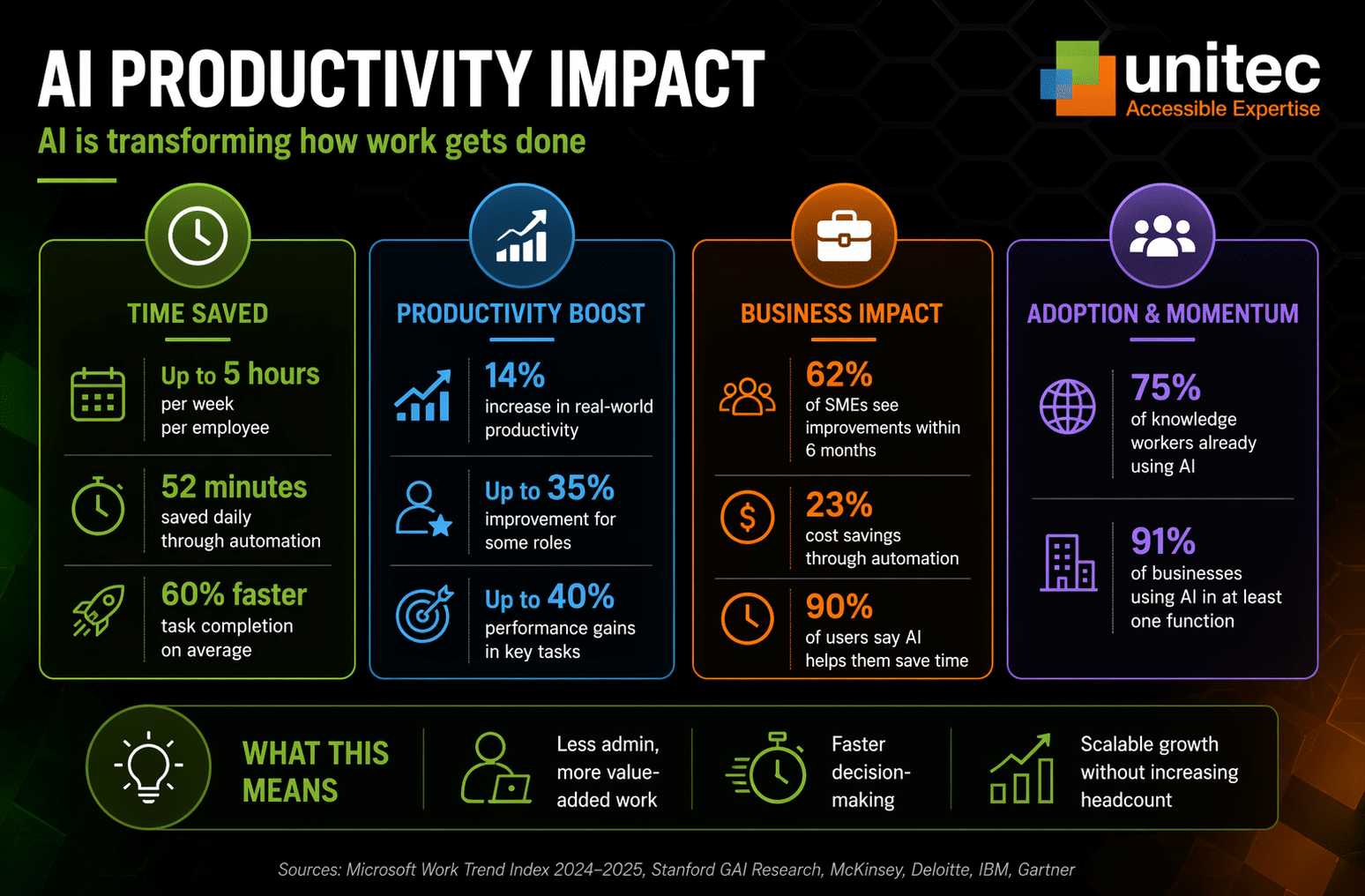
AI is also creating new risk inside organisations. Verizon reports that 45% of employees now use AI regularly, and 67% access AI services from work devices using personal accounts, often outside any company oversight.
“Defenders are using AI too, for faster detection and triage, and that helps,” said Power. “But no AI tool will save an organisation whose firewall hasn’t been patched in two months or whose finance director doesn’t have MFA on email.”
The basics are not basic. They are decisive.
Think of it like protecting your home. A burglar walking down a street doesn’t pick the house with the alarm, the electric gates and the dogs in the yard. They pick the one with the window left open. Cyber criminals work the same way. They scan thousands of organisations at once, looking for the easiest way in, and move on from anyone who makes it hard.
The basics are your alarm, your gates and your dogs. None of them is clever on its own, but together they make you a harder target than the organisation next door, and that is usually enough.
- Unpatched systems are now the number one way in. Nearly a third of breaches start with a known flaw that already had a fix. Yet organisations patched only 26% of actively exploited vulnerabilities in the period Verizon studied.
- Missing MFA keeps opening the door. Among third parties involved in breaches, only 23% fully fixed missing or poorly configured MFA on their cloud accounts.
- Suppliers are part of your attack surface. Almost half of all breaches involved a third party. The credit union incident shows how one weak link can expose dozens of organisations at once.
- People remain the target. With 62% of breaches involving the human element, AI-polished phishing makes staff awareness more important, not less.
“Organisations sometimes see the basics as boring, or as something they already have covered,” said Power. “Then we look closer and find admin accounts without MFA, a VPN two versions behind, and backups nobody has ever tried to restore. That’s the equivalent of leaving the gate open, the alarm off and the dogs inside. Attackers are counting on exactly that. The basics aren’t the beginner level of security. They are the level that decides whether you have a bad day or a disaster.”
Unitec’s seven essentials
Unitec recommends every organisation, whatever its size, confirm these seven controls are in place before year end:
- Patch fast. Fix internet-facing systems, VPNs and firewalls within days of a critical update, not weeks.
- Turn on MFA everywhere. Prioritise email, remote access, cloud and admin accounts, and use phishing-resistant methods where possible.
- Back up and test. Keep offline or immutable backups, and prove you can restore them.
- Limit admin rights. Give people only the access they need, and remove it when they leave.
- Check your suppliers. Ask key vendors how they secure your data and how quickly they will tell you about an incident.
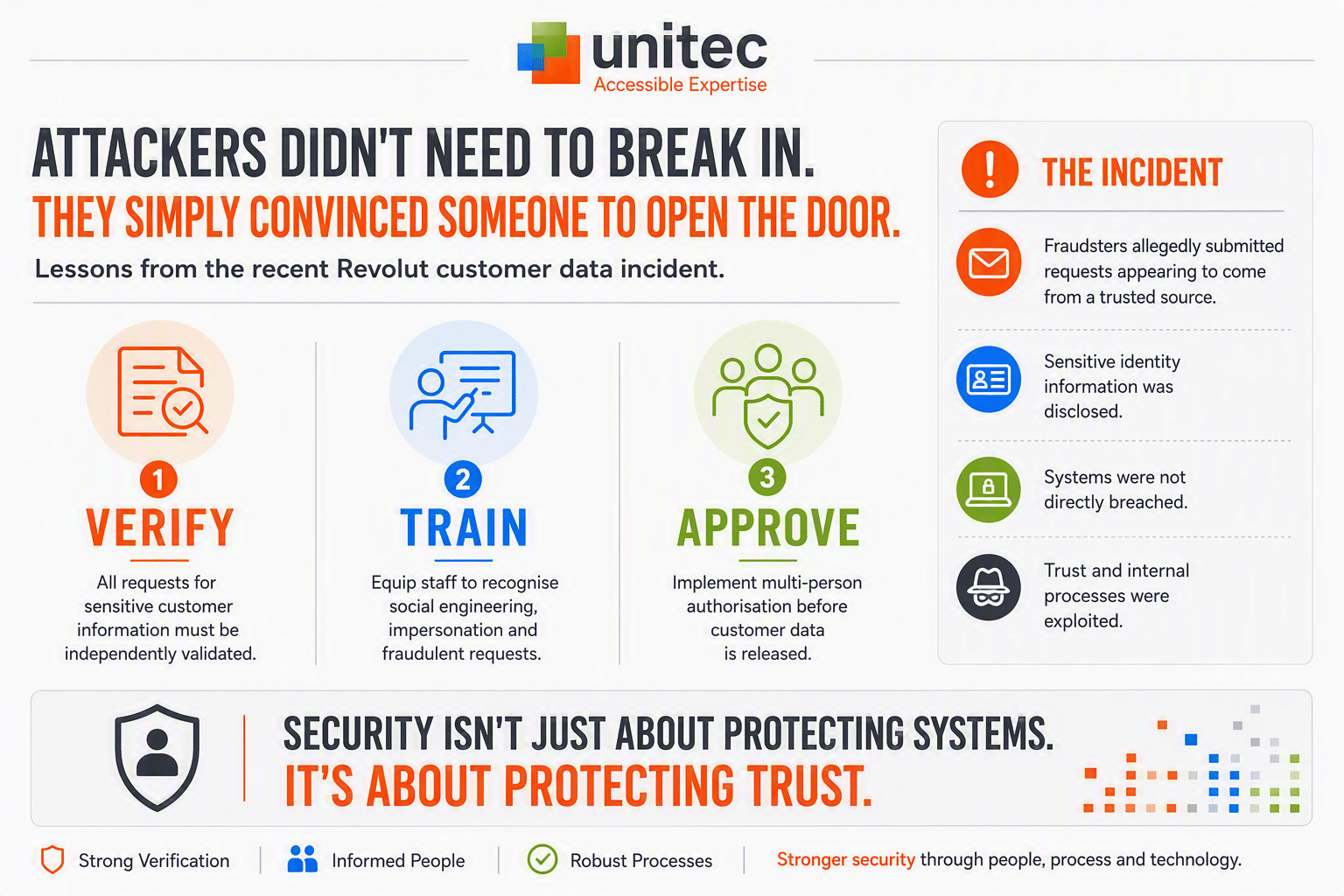
- Train your people. Teach staff to spot AI-generated phishing and to verify any urgent payment or password request by a second channel.
- Set AI rules. Agree which AI tools staff can use and what data must never be pasted into them.
Unitec also advises organisations likely to fall under NIS2 to start preparing now rather than waiting for the National Cyber Security Bill to be enacted.
“Every organisation in Ireland should be asking one simple question this week: if we were hit tomorrow, which of the basics would we wish we had done?” said Power. “Whatever the answer is, do that first.”
Learn more about our cyber crime prevention and recovery tools.